
Applicant Information Meeting (AIM)
The Application and Homeowner Selection Process for FY2026-2027 is Closed.
Please stay tuned for updates on the next application cycle.
Homeowner Selection Process
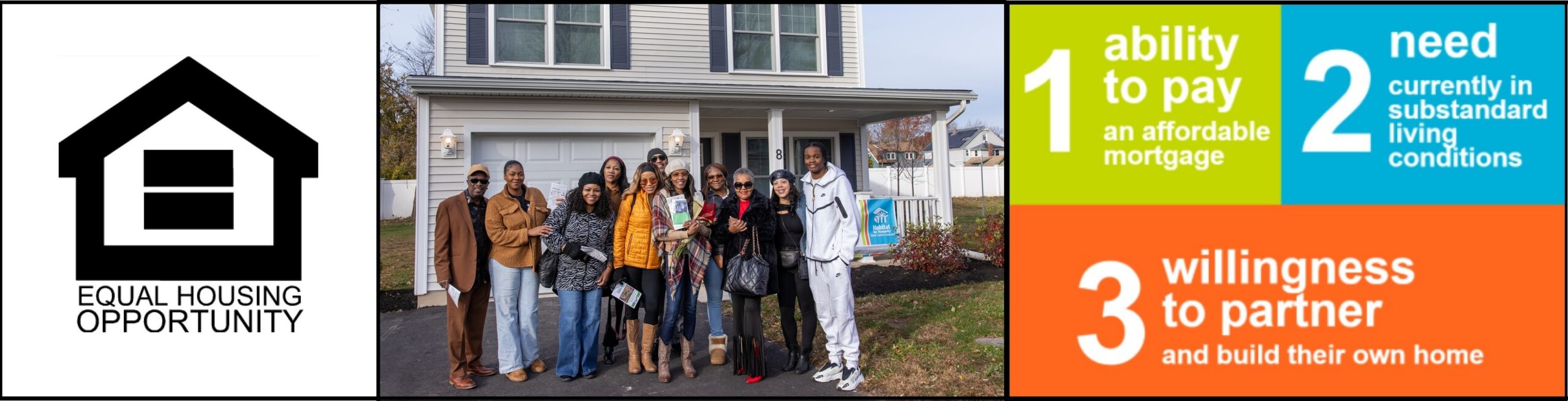
There are 4 phases you must complete in order to become a Habitat Homeowner:
Step 1: Attend an AIM session
Attend an annual Applicant Information Meeting, where you'll learn about the program and receive a physical application. AIM sessions will be announced on the top of this webpage when scheduled. Habitat will never ask you to complete an application electronically or to provide personal identifying information online, over the phone, by email.
Step 2: Complete application & financially qualify
Thoroughly review, complete, and submit the application on time.
You must provide all required documentation, a cashier’s check for a credit report, and mail the full application to the office. All details are outlined in the application.
Please note: Habitat serves households earning between 40 and 80 percent of the Area Median Income. You can find this information on the HUD website: HUD Income Limits FY2026
Step 3: Need Assessment
Habitat staff will conduct a needs assessment by visiting your current residence to better understand your family's housing situation. Factors assessed include but are not limited to the ratio of household members to bedrooms and bathrooms, condition of building, safety of neighborhood, and responsiveness of landlord.
Step 4: Willingness to Partner
You'll participate in a Willingness to Partner Build Day, demonstrating your commitment by volunteering on a Habitat construction site. If you have physical limitations that prevent you from safely traversing a jobsite, accommodations are available.
Program Acceptance!
Once you have successfully completed these steps. All qualify applicants will be reviewed and identified for best available housing. If there is not enough housing available for the applicants who apply, they can reapply the next round or may be referred to other programs.
After entry into the homeownership program, approved applicants begin an exciting partnership that includes saving for a down payment, completing 150 hours of sweat equity, and participating in financial education to prepare for successful homeownership.
Homeownership Benefits to the Family:
- Affordable Home: Zero percent interest rate on the mortgage.
- Improved Education: Studies show that children of homeowners are 25% more likely than renters to graduate from high school and 116% more likely to graduate college, and 20% less likely to become teenage mothers
Homeownership Benefits to the Neighborhood:
- Stability: Studies show that homeowners live in their neighborhood 4 times longer than renters.
- Improve: Homeowners are 28% more likely to repair or improve their home.
- Engaged: Homeowners are 16% more likely to join PTOs and neighborhood block watches.
Homeownership Benefits to the Municipalities:
- Generates Taxes: Habitat converts tax-delinquent or vacant properties into tax generating properties.
- Reduces Expenses: Every time a renter becomes a homeowner, taxpayers save approximately $34,000 in public expenditures (i.e., less money spent on juvenile justice, teen pregnancy, etc.)